Can you use AI music commercially? Copyright, platforms and the terms that decide it
Three different rulebooks decide what you can do with an AI song, and people often mix them up:
Updated
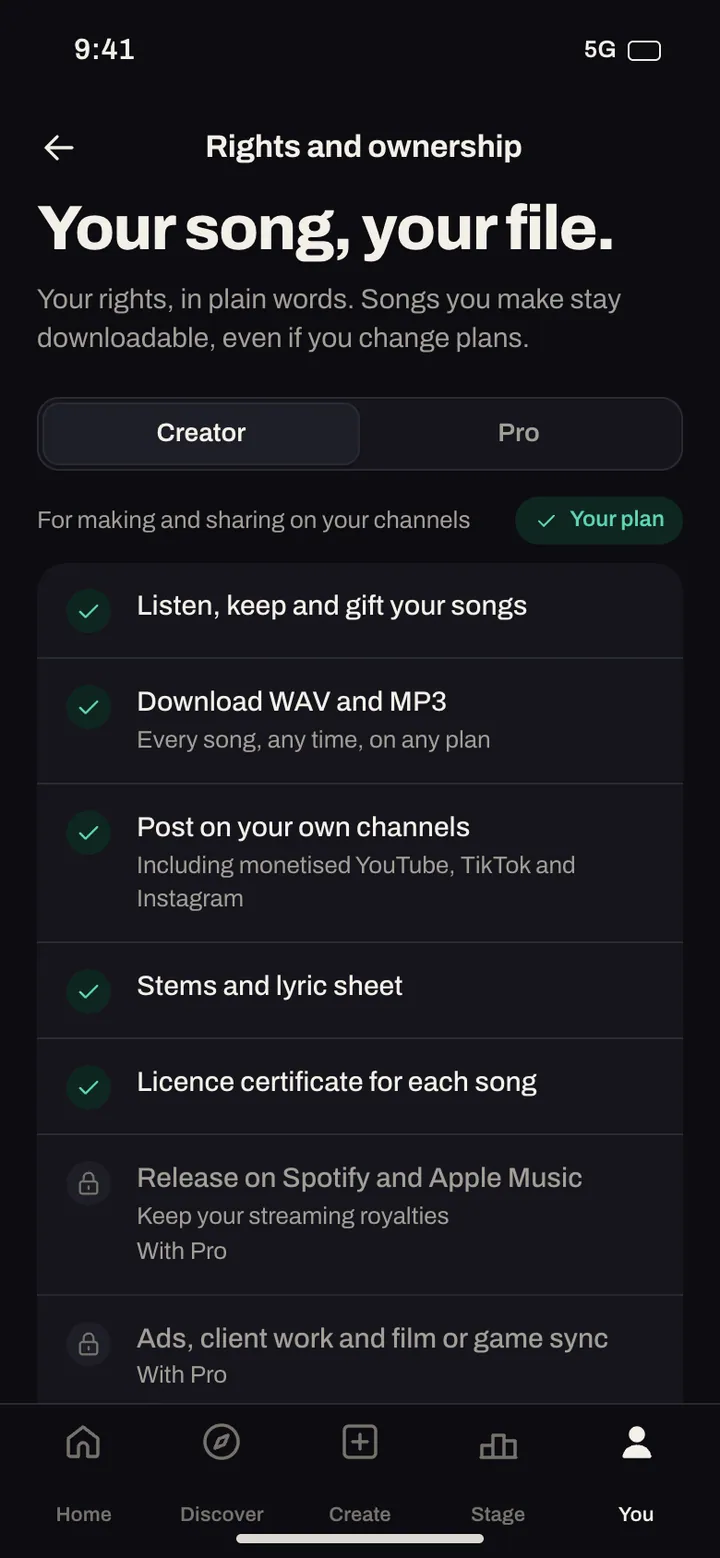
- Copyright law decides whether anyone owns the song at all, and which parts.
- The app's terms decide what the app lets you do with what it made for you.
- Platform rules (Spotify, YouTube, your distributor) decide what they accept and what you must disclose.
This page walks through each, quoting the primary source. It is general information, not legal advice; for a release with real money behind it, ask a lawyer in your country.
1. Copyright: who owns an AI song
The clearest official statement so far comes from the US Copyright Office. Its report on copyrightability (Part 2 of its AI report, published 29 January 2025) concludes:
- "Copyright protects the original expression in a work created by a human author, even if the work also includes AI-generated material."
- "Copyright does not extend to purely AI-generated material, or material where there is insufficient human control over the expressive elements."
- "Based on the functioning of current generally available technology, prompts do not alone provide sufficient control."
- "Human authors are entitled to copyright in their works of authorship that are perceptible in AI-generated outputs, as well as the creative selection, coordination, or arrangement of material in the outputs, or creative modifications of the outputs."
What that means for a song, in practice:
| What you contributed | Likely position under the US Copyright Office's view |
|---|---|
| A one line prompt only | The output is unlikely to be protected by copyright |
| Lyrics you wrote yourself, sung by AI | Your lyrics are your work and protected; the AI generated music is not protected on that basis alone |
| A melody you hummed or played, built on by AI | Your melody can be protected where it is perceptible in the result |
| Your selection and arrangement of parts, or real edits to the output | Can be protected to the extent of your creative contribution, decided case by case |
Other countries are working through the same questions, and collecting societies (GEMA in Germany, SACEM in France, SGAE in Spain, JASRAC in Japan, KOMCA in Korea) have their own registration rules. A Munich court ruled against Suno in GEMA's case on 31 July 2026, at first instance and open to appeal, which shows that the rules for training data are also being settled in court.
The practical takeaway: the more of the song that is yours (your words, your melody, your choices), the stronger your position. Writing your own lyrics in Write it or humming your own melody in Hum it is not only more personal; it is also more clearly yours.
2. The app's terms: what you may do with the output
Even where copyright is unclear, each app's terms set what you may do with the song. They vary a lot, and free plans are almost always personal use only.
| App | Free plan | Paid plans |
|---|---|---|
| Suno | Personal, non commercial use only | Suno assigns its rights in outputs to you, with no promise that copyright exists in them; commercial use only for permitted downloads; remixes non commercial on every tier |
| ElevenLabs Music | Personal use only | Commercial use online and offline, except film, TV and games on self serve plans |
| Mureka | Not stated | "Full commercial rights" for members |
| Soundful | Not for commercial use | Royalty free licence; Plus gives an exclusive licence while subscribed |
| Loudly | Not stated | See Loudly's licence agreement; we could not confirm who owns generated tracks |
| Donna | Songs owned by Donna, personal use with credit | Subscribers own songs made during their subscription |
| Midhull | Personal use | Personal use on every plan; each song's rights card states what your plan allows, and the full terms are published at launch |
All checked on 31 October 2026 at the sources listed below.
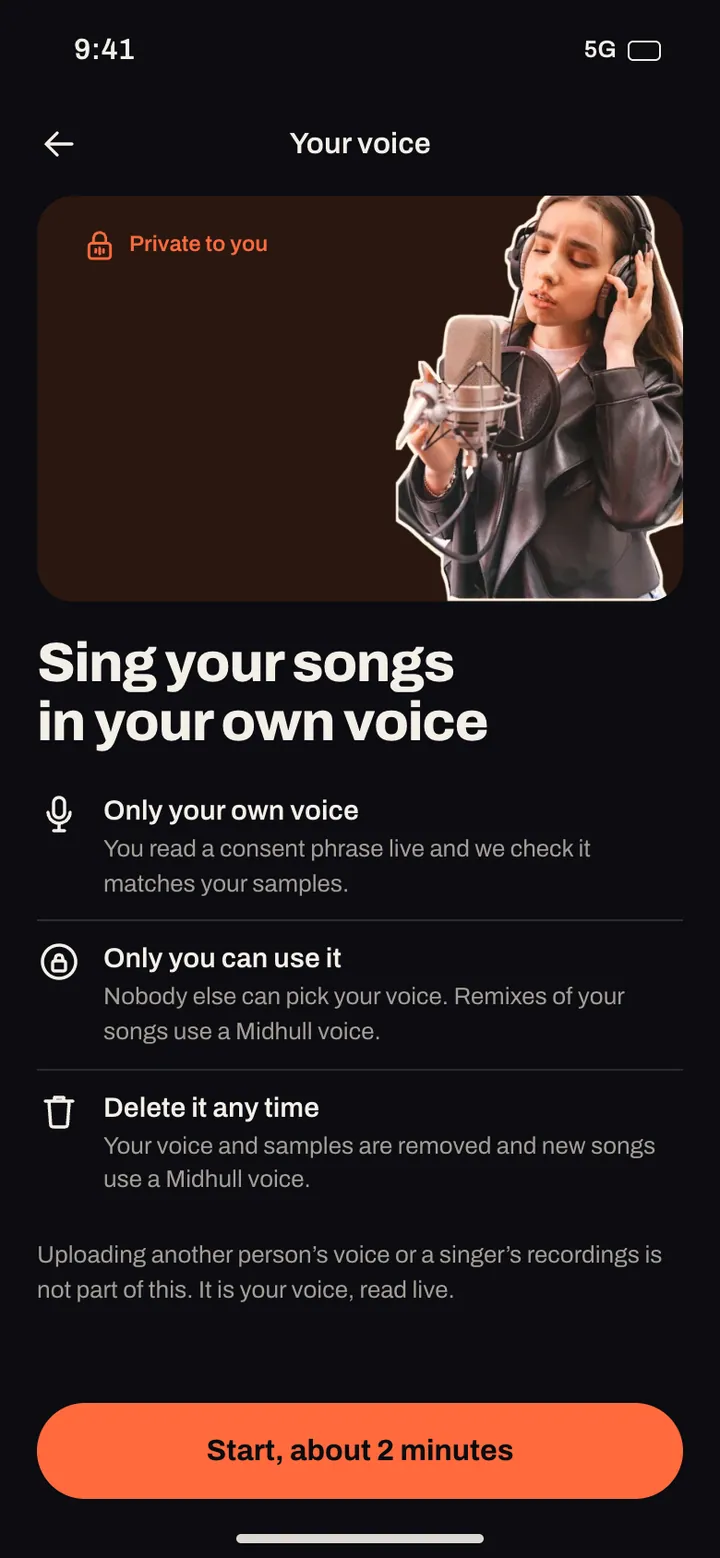
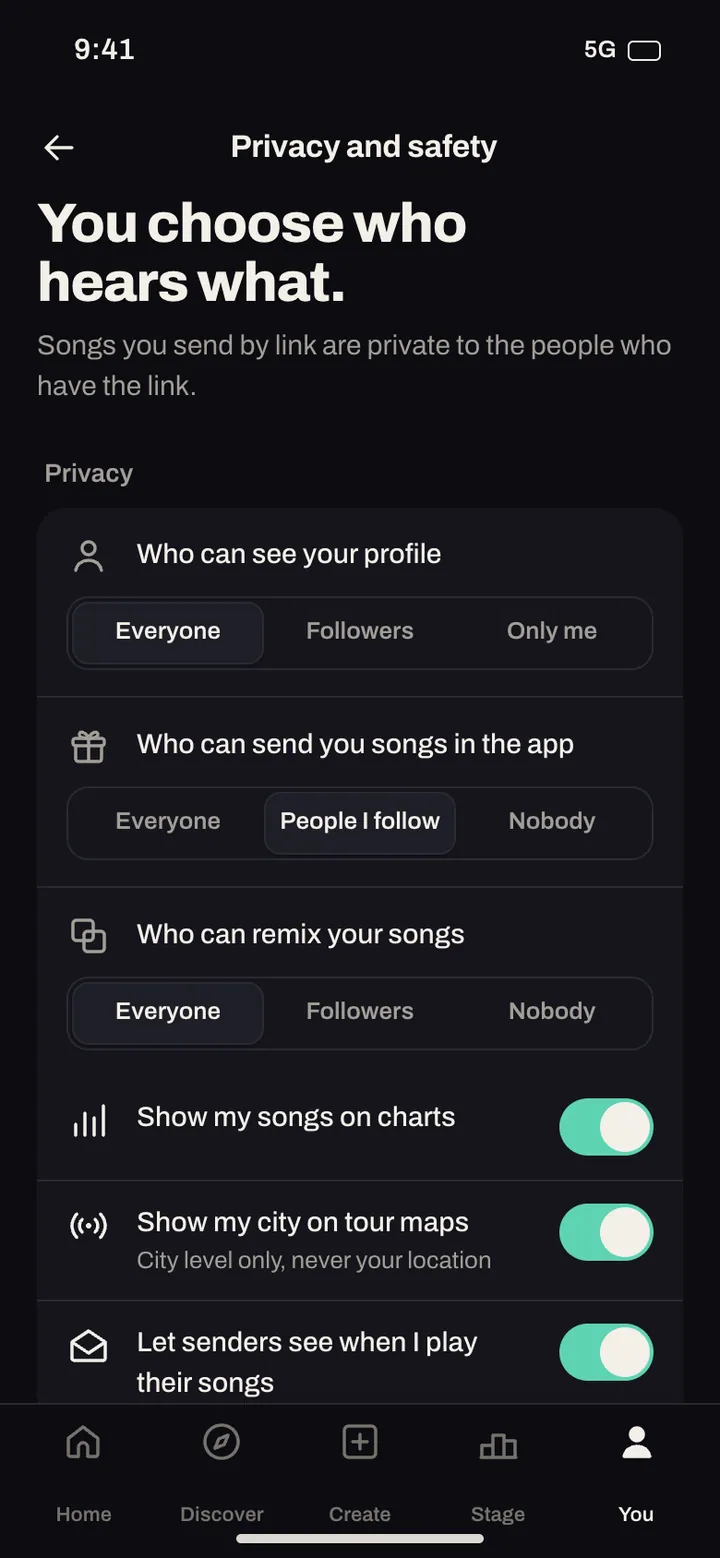
What Midhull does to keep your song clean. Midhull does not imitate real artists: prompts that name one are steered to genre, era, mood and instruments. Your own voice can only be used after a live consent read, and nobody else's voice can be cloned. Sample it only takes your own in app recordings, Midhull's own packs and community songs whose owners allow it; commercial recordings cannot be uploaded to sample, and in app recordings are checked against copyrighted music. These rules exist so that what you make does not borrow someone else's rights.
In the app
3. Platforms: Spotify, YouTube and distributors
Spotify announced its AI music policies on 25 September 2025. "Vocal impersonation is only allowed in music on Spotify when the impersonated artist has authorized the usage." A music spam filter targets mass uploads, duplicate tracks with altered metadata and similar tactics. Spotify also backed a DDEX industry standard for disclosing AI's role in music credits, saying "It's not about punishing artists who use AI responsibly." Spotify releases go through a distributor, so your distributor's own AI rules apply too; check them before you upload.
YouTube requires you to tick the "AI use" disclosure when realistic content is made with AI, and its help page lists AI generated music that is the main focus of a video as an example. "Disclosing AI content alone won't limit a video's audience or impact its eligibility to earn money," but creators who repeatedly fail to disclose can face labels, removal or suspension from the YouTube Partner Program.
The EU AI Act (Article 50) requires providers of AI systems that generate synthetic audio to mark outputs "in a machine-readable format and detectable as artificially generated or manipulated", with Article 50 applying from 2 August 2026. Law firm commentary on the 2026 AI Omnibus reports that this marking duty is postponed to 2 December 2026 for systems already on the market, so check the final text in the Official Journal.
A checklist before you release an AI song
| Check | Why |
|---|---|
| Are you on a plan whose terms allow commercial use? | Free tiers are personal use on every app that states its terms |
| Did you download it under that plan? | Some apps tie commercial rights to permitted downloads |
| Is any voice a real person's voice without their consent? | Platforms and the law treat impersonation as the bright line |
| Does the prompt or lyric copy an existing song or artist? | Imitation creates risk regardless of the tool |
| Did you write the lyrics or melody yourself? | Your human contribution is what copyright can protect |
| Does your distributor accept AI music, and what does it ask you to declare? | Policies differ by distributor |
| Will you disclose AI use where the platform asks? | YouTube requires it for AI music that is the focus of a video |
Frequently asked questions
Can I use AI music on YouTube?
Yes, within your app's terms (free tiers are usually personal use only). Disclose AI use when YouTube asks: its help page lists AI generated music as an example, and says disclosure alone does not limit reach or monetisation.
Can I upload AI music to Spotify?
Through a distributor whose policy accepts it, as long as it does not impersonate an artist without authorisation and is not spam. Spotify supports AI disclosures in credits.
Who owns an AI generated song?
The app's terms set your rights to the output. Under the US Copyright Office's view, purely AI generated material is not protected by copyright, but your own lyrics, melody and creative arrangement can be.
Are my own lyrics protected if AI sings them?
Your lyrics are your original writing, so yes, the lyrics are protected as your work.
Can I use Midhull songs commercially?
Personal use is included on every Midhull plan. Each song's rights card states what your plan allows, and the full terms are published at launch.
Can I make a song in the style of a famous artist?
Midhull steers by genre, era, mood and instruments instead of artist names, and Spotify only allows vocal impersonation that the artist has authorised.
Related
- The best AI music generator apps, compared
- AI song with your own voice
- Turn your lyrics into a song
- Hum to song
- On our site: Safety and rights, Questions and answers
Sources (all checked 31 October 2026)
- US Copyright Office, Copyright and Artificial Intelligence, Part 2: Copyrightability (29 January 2025): https://www.copyright.gov/ai/Copyright-and-Artificial-Intelligence-Part-2-Copyrightability-Report.pdf and https://www.copyright.gov/ai/
- Spotify AI policies, 25 September 2025: https://musicbusinessworldwide.com/spotify-has-deleted-75m-spammy-tracks-as-it-unveils-new-ai-music-policies
- YouTube altered or synthetic content disclosure: https://support.google.com/youtube/answer/14328491?hl=en
- EU AI Act Article 50: https://artificialintelligenceact.eu/article/50/
- GEMA v Suno, Munich, 31 July 2026: https://musicbusinessworldwide.com/suno-infringed-copyright-in-gema-case-german-court-rules
- Suno terms: https://suno.com/terms; Suno pricing: https://suno.com/pricing
- ElevenLabs: https://elevenlabs.io/music
- Mureka: https://www.mureka.ai/subscribe, https://www.mureka.ai/faq
- Soundful: https://soundful.com/pricing/
- Loudly: https://www.loudly.com/legal/terms, https://www.loudly.com/legal/license-agreement
- Donna: https://www.mobiversite.com/terms